Showing posts with label Washington D.C.. Show all posts

Monday, August 8, 2022

Murder of Catherine (Katie) Shands

On August 8, 1922, 28-year-old Ernest Shands would attack his wife 29-year-old Katie with a hatchet. He had the weapon hidden in their home on 225 D street in Washingtion D.C. He had previously threatened to hurt his wife and was jealous of her. On this day he told her to "change her ways" and in response she laughed at him which angered him. He would grab the hatchet and hit her about the head with it.

Katie did not automatically die from this. Police told Ernest that she was still alive and he was quoted telling police "If she ain't dead let me go over and finish the job." Katie would not live long as her wounds were too severe she would die 8 days later on the 16th. 

It only required two hours for Ernest to be convicted. He would then be executed on March 9, 1923.


SOURCES:

Legal Executions page 22

The Washington Times September 17, 1922

The Evening Star September 17, 1922

The Evening Star September 19, 1922

The Washington Herald November 16, 1922

The Washington Herald December 15, 1922

The Evening Star December 22, 1922

The Washington Herald December 23, 1922

Monday, December 27, 2021

Murder of Katie Epps and Louise Hodges

31-year-old George Epps and his wife 32-year-old Katie Epps were separated but had got back together by Thanksgiving of 1921. They were living together in 1105 1st in Washington D.C. He was believing that a friend of Katie's 24/27-year-old Louise Hodges was the reason for Katie's mistreatment towards him. He was also believing she was leading her astray to infidelity. 

On the day of  December 28, 1921, George withdrew some money and called into work claiming to be ill. He would then take the money and go to a second-hand store on D street and purchased a revolver. He would then shoot the two girls. Katie would be shot in the right breast and the center of her forehead. Louise was shot in the abdomen.

When police arrived he stated "Here I am. I have been waiting for you." He handed his gun over to the officers and surrendered himself. The girls were sent to hospital but were soon declared dead shortly after arriving.

SOURCES:
Evening Star  December 28, 1921

Wednesday, October 6, 2021

Murder of Fanny Faulkner

In 1870 75-year-old Fanny Faulkner was a charity pensioner in Washington, D.C. She was living in a single apartment on Ohio avenue, in Washington. On the day of October 6, 1871, 32-year-old James Grady had horrible plans for the 75-year-old.

On October 6, 1870, James "Jimmy" Grady went to the home of Fanny Faulkner drunk. He had foul plans for the elderly woman. He sexually assaulted her and intended to rob her. He would beat, strangle and kick the woman. Mrs. Curtin was told by some children at the grocery store that Jimmy Grady was at Franny's home eating food.

This worried Mrs. Curtin and she rushed to Fanny's home. Inside he saw James over Franny. Franny laid on the floor suffering and unable to speak. James left after Mrs. Curtin arrived. James went to a blacksmith shop nearby and bragged about assaulting Fanny. Franny ended up dead the next day from the injuries.

At trial, he plead not guilty. The jury found him guilty and he was sentenced to death. James tried to get a new trial due to 1. him being intoxicated during the crime, 2. He didn't intend for murder just rape, 3. he was possibly from an influential family, 4. He wasn't skillfully represented.

This did not happen and James Grady was hanged on March 24, 1871.

SOURCES:
Legal Executions in Deleware, District of Columbia, Maryland, Virginia, and West Virginia page 15
Evening Star Jan 19, 1871
Alexandria Gazette Jan. 20, 1871
Evening Star Jan 24, 1871
The Baltimore Sun March 15, 1871

Tuesday, May 18, 2021

MISSING: Flora "Dan" Ligon (Green, Greene, White)


During the Spring or Fall of 1956 in Washington D.C. the daughter of 41/42-year-old Flora "Dan" Ligon last saw her mother getting money from under the linoleum. Flora told her daughter she was going to the store and did not return. Flora may have traveled to Trenton, New Jersey, or Greenville, or Clemson in South Carolina. Flora has a history of alcohol abuse. Flora may have been a victim of foul play. She may be using the last names Green, Greene, or White. 

Flora is an African American woman and was 41/42-years-old at the time. She's 5'6" to 5'7" and 130 lbs. She has brown hair and brown eyes. Her ears are pierced. She was wearing a blue jacket, white shirt, and grey pants at the time of her disappearance. 

SOURCES:

Thursday, October 29, 2020

Murder of Ada King

In 1919 20/21-year-old Josephine Berry and 18-year-old Ada King were two colored neighbors in Washington, D.C. The two did not get along and some news articles claimed that they were fighting over a man. But it could have been over a previous assault.

On the morning of October 29, 1919, Ada and her husband had come home after he was acquitted of assaulting Josephine. At 11:30 a.m.  Josephine shot Ada in the neck and killed her. Josephine would claim it would be in self-defense and that she was "Tired of being the dog for one crowd of people."

After the shooting Josephine would go and sit the front door of her home waiting for police. She refused to be arrested by police out of uniform.

Ada's husband would claim that a friend of Josephine's a 19-year-old Howard Dudley gave her the gun. Josephine would say that she didn't see Howard that day and that she had gotten the gun from under a pillow.

When she was found guilty and set to hang Josephine fainted in court. People were advocating for Josephine to get life in prison instead of being executed. Petitions were sent out to be signed. Her hanging would be postponed several times and on October 14, 1920, a day before she was to be hanged President Wilson commuted her to life in prison.

Because  of Josephine's small stature of being 5'0" and 70 lbs if she was to be hanged weights would have to be tied to her feet so that her neck would have broke.


SOURCES:
Evening Star October 29, 1919
The Washington Herald October 31, 1919
Evening Star December 29, 1919
The Washington Herald Jan 24, 1920
The Washington Times February 21, 1920
The Washington Times February 22, 1920
Evening Star October 7, 1920
The Washington Times October 14, 1920
The Washington Post October 15, 1920

Thursday, August 6, 2020

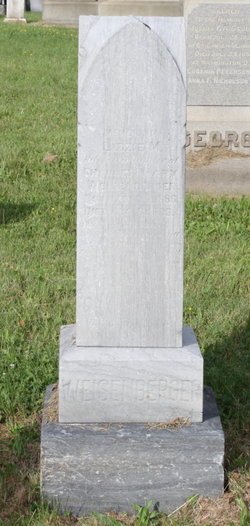
Murder of Lizzie Weisenberger


By the spring of 1899 13-year-old Lizzie Weisenberger was living with the Snell family in Washington, D.C. for 5 years. She was hired as a companion for their daughter Blanche. Her family knew the Snells and trusted them. But by spring of 1899, Lizzie who was previously happy with the arrangement was now unhappy. 

She would start to beg her mother to let her come home. It had turned out that 57-year-old Benjamin Snell, Blanche's father, was molesting Lizzie. She would tell her mother what he was doing to her and she let her come home. She would then try to keep Benjamin from Lizzie. It's not stated whether or not Lizzie's father, Karl, knew about what Benjamin did to her. 

Benjamin would start to beg for Lizzie to come back. 

At 6 a.m. Benjamin came to the Weisenberger home and asked for a glass of water. There was no water in the home so Karl left with a bucket to get some. Once Karl left Benjamin went into the home. Inside Lizzie was still asleep and her mother was in the kitchen cooking. When she saw him she screamed at him to leave. Instead, he rushed to Lizzie's room.

Her mother followed him but was not fast enough to stop what he planned. He would take a razor out, grab the girl by her hair waking her up, and slice the girl's throat twice. "Yes, I cut her throat, and I will cut yours, too!" He screamed at her mother. He would slash the razor at her cutting her arm before he fled the home.

A mounted police officer, Pat Creagh, would quickly find Benjamin. He had the razor in his hands and stated "I didn't mean to do it. I wouldn't be surprised if I hanged for my folly." Officer Creagh disarmed him and Benjamin would follow meekly. He was also said to be confused about why he was being arrested that he

Benjamin's defense would try to get an insanity plea for him. Stating that mental illness and alcohol was the reason for the murder. He said that a head injury that led to epilepsy was the cause and that bad blood was another as his parents were also cousins. He would then claim that he didn't remember the murder. Throughout the trial, his family stayed by his side.

The jury would find Benjamin guilty. He was set to be executed. By the time that he was executed he lost about 60 lbs and became mentally unstable. His family would beg for clemency. He would hang on June 29, 1900.


SOURCES:
Legal Executions in Delaware, the District of Columbia, Maryland, Virginia, and West Virginia page 19
Find a Grave
New York Daily News
Horror History
Washington Times August 13, 1899
Evening Star
The Baltimore Sun June 29, 1900
The Weekley News July 3, 1900

Thursday, May 14, 2020

Murder of Lavinia Jenkins

On May 13, 1872, 20-year-old Lavinia Jenkins and 24-year-old George Jenkins had a fight. George had been drinking on and off that day and came home at 8p.m. Late that night around  9 p.m. Lavinia wanted to leave the house. She at first said she was going to her sisters-in-law, but George told her no and she then told him she wanted to go to church. He told her to not leave and to go the next day.

George would then leave to go to the lodge returning home around 10. When he came home Lavinia was not home. So he went and sat on a bench between his and the neighbor's house. Lavinia would return home with a man (known to George, but not stated who it was). Lavinia called out to George and looked for him.

When she found him beside the house she was offended. She thought that George was trying to spy on her and she was angry. The two said goodbye to the man who walked her home. Once he was gone Lavinia lashed out at George telling him "I don't need you watching me." They would get into an argument leading George to drink more.

He would go and borrow a meat cleaver claiming he was going to cook meat for breakfast. Lavinia was still sleeping when George took a cleaver to his wife. He would hit her in the face, throat, shoulders, and chest.

When Robert, George's older brother, came to the house around 9 a.m. the next morning the doors were closed and the two children were outside playing. He would ask them where their mother was and one of the children would tell him, "Mother is upstairs dead."

Robert believing something was wrong went to the police station to retrieve officers. They would return to the home and forcibly broke down the door. Inside they found Lavinia still in her blood-soaked bed and George was nowhere in sight.

George would turn himself in. He would claim that he did not remember what he did to his wife. He said that he was drunk and blacked out and during the blackout out he murdered his wife. He would take an insanity plea at trial. He would also state that she would not treat him as she should have. They would find him guilty and set to be executed an on October 31, 1872, George would be executed.

SOURCES:
Legal Executions in Delaware, The District of Columbia, Maryland, Virginia, and West Virginia 
The Baltimore Sun May 15, 1872
The Philidelphia Inquirer May 15, 1872
Evening Star June 27, 1872
Evening Star October 4, 1872
Evening Star October 31, 1872