Showing posts with label Murdered Teenager. Show all posts

Friday, January 10, 2025

Death of William Snyder/Bernard

On January 11, 1854, 13-year-old William Snyder went to a circus on Stockton st in San Francisco, California. There he would be grabbed by the ankles by Manuel Reyes.  He was swung by his heels by the clown and this would lead to his death. It was said the blood was coming from Williams's mouth. He would be sent to the hospital where he would die a few minutes after He would die from a rupture of the left pulmonary artery. The next day he would be buried.

Manuel was described as being a mentally handicapped clown. He was arrested for murder, but nothing came from it. Williams's cause of death was determined as accidental. Later he would be arrested for assault and battery upon an officer. During the court hearing he “commenced slapping his face as if a swarm of mosquitos were pestering him” and was muttering nonsense. 

In some articles, William's last name was Bernard instead of Snyder. 
Nevada Journal Jan 20, 1854

Tuesday, November 12, 2024

Murder of Jesa "Toni" Rose Corazza


In 1934, 17-year-old Jesa "Toni" Corazza was a dancer and lived on Randor St in the Chelsea area of London, England. She acquired certain fame in theaters and even had a part in one or two films. By October she would become pregnant and did not want to keep it. At this time abortion was illegal in England and would seek help and have one illegally. On October 28, 1934, Toni would miscarry and be sent to St. Luke Hospital in London, England. 

Toni denied that she had an abortion and claimed that she fell dancing, but there was evidence of an instrument used by someone accustomed to this type of work. It was also found that she was taking pills to induce a miscarriage and they were hidden inside a matchbook inside her purse.
 
Toni would develop acute blood poisoning due to the instrument used in the surgery. She would not admit to either who the father was or who had given her the abortion. She would even say that she may have slipped on accident while dancing as an excuse for her condition. She passed away on November 13th due to heart failure caused by the blood poisoning. 

Her mother said that she didn't know if anyone had interfered with her daughter. She stated that Toni tried to tell her something as she was dying, but she couldn't be understood. 

A jury would find a verdict of murder against some person or persons unknown was returned.

SOURCES:
Evening Standard November 19, 1934
Evening Standard November 26, 1934

Wednesday, April 10, 2024

Murders of Thomas Smith and Squire Knyston

Photo of Thomas Smith


On April 4, 1905, 15-year-old Thomas Smith would leave his home on Wood Street in Chorlton-on-Medlock in Manchester, England. His mother would think that he was looking for work. However, the timid boy would not return home that night. It was assumed that maybe he had gone to visit either his sister in Dunkinfield or the one in Denton. 

The next day two boys he knew came to the house and asked if Thomas was going to work. Not knowing where Thomas was and not wanting him to lose his job she sent a note to his employers that he wasn't feeling well. However, she was worried sick about him. She would make inquiries to see if he was at either sisters, but he wasn't.

At 3pm on April 11, 1905, a rag-and-bone men would go to an uninhabited house on Hoyle Street off Fairfield Street in Ancoats. While gathering items he looked in the cellar window a body would be found lying on his back under a slab. He would tell another rag-and-bone man his discovery and the two would go to the police. 

The police would break into the home and go down to the cellar. It was obvious that the boy was murdered brutally. There was a bloody brick on his neck. A newspaper comic of "Funny Cuts" from April 8th was found stuffed in his mouth as a gag and his red handkerchief with 7 black stripes was tied over it. He was partially dressed and what clothes he had were torn and disarrayed. His pants were pulled down in the back and cut in the front. 

 His face was so beaten that he was unrecognizable. His body was also covered in bruises. He had fought back with his attacker that the nail from his middle left finger was torn off. His arms were covered in scratches he wasn't just beaten, but also stomped as a boot print was on his stomach. His genitals were also mutilated while he was alive. 

It could not be said if he was sexually assaulted, but it was suspected that he was. 

Even though the brick was bloody and found at the scene the coroner believed that a knob-like object was used to beat him. 

It was thought that he had been dead for a couple of days even though he had been missing for a week. It's not stated if they think he was held prisoner, but they know that the crime didn't happen in the cellar he was found in. The only access was a window as the doors to the cellar were locked. 

He had not been reported missing, but when the description was put in the paper his mother knew it was him. His mother and older brother, Issac, would go to identify him. They could not identify him from his face due to the brutality on it. Instead, they identified him by his clothes. At the time he was dressed in a black Vicuna jacket, black vest, dark grey trousers with black stripe, blue and red striped cotton shirt, two odd black stockings, and clasped clogs. He also had in his possession a second-class ticket for the swimming bath, Mayfield Baths, number 7,837.

In 1906, 15-year-old Squire Kynston lived with his mother at Whitsuntide at 7 Back Grey Street in Manchester, England. In August he and his mother would get into an argument after he had stayed out all night. She saw him the day after he stayed out on Butler St. She would say "You naughty boy, go right home and stay in the house" while slapping him on the side of the head. She would never see him again after this argument. 

Someone had told her later he was with his cousin. She would assume that Squire was staying with her sister and assumed he was safe. She did not check up on him however since she and her sister did not have a good relationship. It wasn't stated if he was staying with his aunt or just assumed he was. 

On Chapel St behind London Road Station, there was an unoccupied house set to be demolished. On November 20th A workman would enter the house. He stated when he entered the ground floor rooms of the home there was a stench in the air. He would find out that the stench was coming from the cellar. He would go down the stairs nearly tripping over something. It was Squire's body. The worker would quickly go and get the police. 

One of his shoulders was under a slab of flag and his head was partially under a slope stone. Squire was not wearing any clothes when he was found, but a thin strap was found wrapped around his neck. It's believed it was wrapped tightly around his neck. It was unknown what his cause of death was as he was too decomposed and rats had been eating him. However, it was believed he may have been sexually assaulted as his pants were not on him. He was not beaten on his head like Thomas.

Though both boys had died in different ways, the way they were found in similar ways and places. 


SOURCES:
Manchester Evening News April 12, 1905
Leicester Mercury April 12, 1905

Friday, December 29, 2023

Murder of Anne Noblett


On December 30, 1957, 17-year-old Anne Noblett went to dancing classes and rock and roll lessons at the Lourdes Hall in Harpenden, England.  It was just after 6 p.m. when she left to go home alone. She had gotten off of the bus at Cherry Tree Corner, Marshalls Heath, near Wheathampstead, and began her walk home. Another local girl passed by her as she was walking on the lane and this was the last time anyone saw her. She never made it to her home which was only a quarter of a mile away. 

No one had known what had happened to the teenager for a month. During that time there were inquires and searches for the girl. Her last bus ride was even reconstructed in order to help find the girl. Searches with hundreds of volunteers were done, but she still could not be found. It could have been that someone she knew offered to give a ride or someone abducted the girl.

On January 31, 1958, Anne's body would be found in dense woodland in Rose Grove Woods in Horn Hill by brothers and their dog. This area was seven miles away from her home. Her items were found nearby her body. It's believed that her body had been there for at most 2 weeks. 

It is believed that Anne was murdered within hours of her disappearance. Even though her body was clothed there was evidence that she had been redressed likely meaning she had been sexually assaulted. She was then strangled to death. Someone then deep froze her body as the temperatures were mild and there was no possibility of it happening naturally. They then carried her body to where it was found. 

Oddly enough if they had carried her only a few dozen more yards she would have been hidden better. The area she was laid on was considered a relatively open area of wood. There was also a disused cart tract near where her body was found that was inaccessible to cars and the closest tracks were half a mile away. Whoever carried her had to of been strong enough to carry her as there was no evidence of dragging.

Police searched all deep freezing machinery within a 30-mile radius of where her body was found. Farmhouses, buildings, outhouses, and factories were all searched.  There was no evidence of any of them had been used for her body. 

SOURCES:
Wikipedia
The Daily Telegraph January 7, 1958
Evening Sentinel January 7, 1958
The Guardian January 23, 1958
The Guardian February 3, 1958
The Birmingham Post and Birmingham Post July 14, 1958
Watford Observer January 30, 2002
The Comet December 21, 2017
BBC April 29, 2018

Sunday, December 24, 2023

Murder of Albert Lucia

 On December 24, 1883, 30-year-old Christian Reibling (white) was drinking with another man alcohol diluted with water. That Christmas morning they continued drinking a bottle of gin. At a livery stable in Lyndon, Illinois Christian would argue with 19-year-old Albert Lucia (white). It would result in Christian shooting and killing Albert.

Christian would be arrested. He would state that he could remember drinking the bottle of gin, but nothing after. He regretted what he had done and acknowledged he should not have been drinking with his pistol. If he was sober he would not have killed Albert as he had no reason to.

Christian would go to trial and would be found guilty and set to hang. He was to be the first hanging in Whiteside County.  Christian was accepting of his fate and felt remorseful for the killing. He believed that he would be accepted in heaven even for his crime because he was not in the right mind and had no actual malice towards Albert. 

SOURCES:
Chicago Tribune May 16, 1844

Monday, July 3, 2023

Murder of Harry Ecklind Blochman


Harry Ecklind was born on May 12, 1888, to Swedish parents in Santa Maria, California. His father, a musician, would die as when he infant and a few years later his mother would join him. Knowing her son would become an orphan, before her death, his mother would come in contact with the Blochmans. The childless couple would take in the boy and treat him as if their own.

Lazar and Ida Bolchman were known as charitable people. They would take homless and less unfortanate people in. Lazar was both a businessman and columnist for the Santa Maria Times where he would write about economic and sociological issues.Ida was the vice president of the Santa Maria Union high School, and a member of the Board of Education of Santa Barbra County. She also was a a high regarded Botonist in Santa Barbra County.  

Harry's name would be changed to Harry Ecklind Blochman was known as a happy, handsome and smart child. He seemed to inherit some of his father's artistic abilities and the Bolchmans wanted to nurture those talents. 

On the night of July 3, 1901 Harry stayed out late that night. At 8:30 he was seen heading home, and at 9 he was seen talking to two men a block away from home. The two men seemed to have been threshers and one of them seemed to be drunk and this was the last time anyone saw Harry alive. 

While the town celebrated the 4th the Bolchmans worried about their young son. The same night he went missing the Strong boys reported that their horse and buggy had been stolen from in front of Haslam's store around 9:30 pm. It was found in Guadalupe the next day with the horse exhausted. 

Police suspected that Harry may have been abducted. The police kept asked about the trains leaving the Guadalupe area. Police found out that a man had been on a train about 11:30 he pretended to be asleep and his his face. When the conductor asked for a ticket he didn't have a ticket, but did pay to go San Luis Obsipo. This led nowhere though.

On July 6th around 7 p.m. two children were playing in their back yard. They noticed something a bean field not far from the Bolchman's home. They would stumble upon Harry's body about 1/8 of a miled from the road. The children's father notified the Blochman's before the police.

He was greatly decomposed and there was a struggle in the bean field. There were 9 knife wounds 4 of which could have caused his death. Two in the brain and two in the heart. It appeared that he tried to crawl towards his home before he died.

A man named William Kelso was believed to be the one who was seen speaking to Harry the night he died. Police would bring in a man named Kinkaid and arrested him as an accomplice. He allegedly knew that Kelso was the one that stole the horse and buggy that night, but he was released. 

William would be found in Templton under the name Jackson working on a ranch. Sheriff Ivans would come up and arrest him. He would take him by train back to Santa Maria, but because there was rumors of a lynching he had William hide behind several large trunks in the baggage compartment. There was no lynch mob waiting for them. 

William would be charged and would go to trial for the murder. On October 9, 1901 William would be found not guilty of the murder. It only took the jury less than 45 minutes which was unexpected as many believed that it would take longer.

 There were no other suspects in the case. It's unknown if William Kelso had done the crime and if not the real culprit will remain unknown. 

SOURCES:

Find a Grave

SMV Historical Society Museum

The Fresno Morning Republic July 7, 1901

San Fransisco Chronicle July 8, 1901

Santa Maria Times July 13, 1901

San Fransisco Chronicle October 10, 1901

Hanford Kings County Sentinel October 17, 1901

Santa Maria Times November 21, 2010

Santa Maria Times November 9, 2014

Friday, June 23, 2023

William Zinsmeister Shoots up a Picnic

 On June 23, 1923, 35-year-old William Zinsmeister would question his son-in-law. He would inquire where his daughter, 15-year-old Mamie, was attending a picnic for the St. Williams Catholic Church in Louisville, Kentucky. He would then ask who she was attending with and if it was the boy he disapproved of. He would then call a taxi to come get him at his soft drink stand at 1:30 p.m. 

Before leaving he would tell his son-in-law that he "I'm going to kill 5 kids this afternoon". His son-in-law would try to make it to the river before him. He left in the taxi with two revolvers and over 75 rounds. The taxi would bring him to the picnic area of the Ohio River. There was nothing unusual about how William was acting in the taxi.

When they arrived William would leave the vehicle and walk towards the river. The Taxi driver would stay and chat with someone. He would then walk down to his daughter who was sitting on a log next to the water. 18-year-old Thomas Mullaney and 16-year-old Sarah Connolly were in the water near her. 

William would be greeted by Mamie saying "Hello Daddy." He would then ask his daughter "What are you doing out her Mamie?". She responded with something along the line of to have a good time and her father's response was "Well I'm going to kill you." He then pulled out and began shooting. 

Mammie died almost instantly with two shots to the head. He then began shooting at those in the water. 16-year-old Sarah Connolly would be shot and killed. 16-year-old Gertrude Franconia, and 18-year-old Charles Eifler would be injured. Thomas would be able to get one of the revolvers from William and received a wound to the shoulder and was hit on the head. 

Those witnessing the madness would run screaming towards where the Taxi was parked. "He's shooting people in the water." After the shooting William would flee across fields on foot towards his childhood home and where he was born. He was a few hundred feet from his former home and would kill himself. 

There were only two deaths, Mamie and Sarah. Sarah's body was washed away and a search would be done for it. She wouldn't be found for two days. Her body would be found down stream about a mile from the scene. The rest were injured with non life threatening wounds.

SOURCES:

The Puducah Sun-Democrat June 25, 1923

Messenger-Inquirer June 25, 1923

The Courier-Journal June 25, 1923

Hinton Daily News June 25, 1923


Wednesday, April 12, 2023

UNIDENTIFIED: April 13, 1989 New York City, New York, John Doe

 On April 13, 1989, the skeletal remains of a teenage boy were found in the basement at 12 Eldridge St. in New York City, New York. The remains were found during construction and renovation. A bottle dated from the 1930's was found in the same area. It's not stated what respect to the body the bottle was found. It's believed that he died from 1930 to 1960. 


John Doe was an African American male between 14 to 17-years-old. He was 5'2".

SOURCES:

Thursday, February 3, 2022

UNIDENTIFIED: February 1915, Harrisburg, Pennsylvania Unknown Girl

 In February 1915 a body (believed to be a teenage girl) was found in the basement of a home on 133 s 14th st, Harrisburg, Pennsylvania. A plumber was going to lay a sewer in the basement and the skeletal remains were found underneath the stairs from the outside access. The stairs had to be removed in order to get to the body. so the killer would have removed them also. The grave was shallow and was 2 by 3 ft. This would mean the girl was doubled up or her remains dismembered. The skull seemed to have evidence of an injury with a sharp object like a hatchet. Her remains had been burned and quicklime was poured on the body. It's believed she could be dead for around 10 to 15 years. 

Jane Doe was a teenage girl around 16-year-old. She had chestnut brown hair. a piece of cloth was found with the body and it's thought of being similar to the end of an apron string possibly made out of white muslin.  

SOURCES:
Harrisburg Telegraph Feb 13, 1915

Monday, January 17, 2022

MISSING: Marga Hillmer


On Jan. 18, 1949, 16-year-old Marga Hillmer went to her vocational school in Westersted, Germany. After school, she and two classmates cycled back to their homes that were 7 kilometers away in Ihausen. At the exit of the forest, the girls separated and Marga was to ride alone for a few hundred meters to her home. She would never make it back home. 

There was evidence of where she was before she was abducted on the path she would have taken home in Ihorst.  Her bike was found in a ditch with her trouser clip and her comb was 250 meters further up the path. There was evidence of a struggle and she was nowhere to be found. Police and the locals searched for the girl everywhere for days, but there was no sign of her.

Marga is a white female and had just turned 16 on Jan 2nd. She had blonde hair.

SOURCES: 

Saturday, December 25, 2021

Murder of Albert Lucia

On December 25, 1883, 32-year-old Christian Reibling was drinking early for the holiday in Lyndon, Illinois. Already drunk he went to the general store of C.W. Parkhurst looking to buy more alcohol. He got mad when he was told that the store did not sell liquor anymore. This angered him and at the same time, 19-year-old Albert Lucia came into the store.

For some reason, his anger was focused on Albert. He would then threaten Albert with his pocket pistol and tell him to leave the store. Albert being the meek and harmless type of youth left the store and went to a livery stable owned by Constable G.R. Cady. It was probably to seek some protection.

Christian not knowing that the boy went to the livery stable went there also. He would then see Albert laying on a pile of blankets and would get angry again. He would threaten him and told him to leave. 

Albert would state he did not have to get out unless Mr. Cady said so. Mr. Cady would stay silent and not request the boy to leave. Christian would then get his gun out and point it at Albert as he stood between him and the door. Telling him he had to leave. 

An effort was done in trying to take the gun away, but a shot was fired and hit Albert in the leg. It would shatter the bone. Albert would not die automatically, but his wound would cause infection and Albert would die on Jan. 5, 1884. 

He would admit that he did not remember the murder. That he had been drinking diluted alcohol the day before and a bottle of gin with a friend the day of. He stated that if he was in his right mind he would have not hurt the boy. At trial, he claimed that a smallpox sore he had in his head had helped cause him to murder the boy also. He said he regretted his actions that day. He would be found guilty and set to hang on May 16, 1884, in Morrison, Illinois.

Christian's last night was spent will no incident. He went to bed a little later. He was awake by the time the jailer came to his cell at 7 a.m. and stated that he slept very well that night. He was a little nervous and his stomach was upset. He didn't want the eggs and ham that was for breakfast, because he had no appetite. He did want coffee though of which he drank profusely. He would pray continuously that morning mostly in German. 

He would then see Reverend T.E.V. Sweet and Reverend Edward Breen. Prayers were offered to him and he would pray and talk as he walked around. The Sherrif's daughter at one point offered an orange to him to which he ate, and he smoked two cigars. 

At his request, the Sherrif and three members of the church choir would sing to him some religious songs. During the midst of this, he began to cry and he went back to his cell to conceal that he was crying while listening to them sing. 

He said the crying wasn't because of regret, but because of the religious ecstasy, he had drifted away from. He felt that he had been forgiven for his sins. He was accepting of his fate but admitted that it was hard to face the gallows. 

Around 150 people from the surrounding area came to see Christian hang. People were dressed in their Sunday best. Few who came were admitted into the enclosure, none of which were women. Though many women also came to watch the execution. 

His last words were; "Well," he said smiling sadly and bowing to the crowd." I am sorry for what was done and don't have unkind feelings toward anybody, and hope they have none against me. I believe I will be saved, for Christ died for our sakes. I believe it just as firmly as I live. I hope I shall go to a better place and I believe I will be saved by Him." He would hesitatingly look at the sheriff and smiled. "And I want to thank the Sheriff Mr. Beach for his kindness. He had always treated me as a gentleman." He then looked at the deputy sheriff. "Mr. Cole has also been kind to me so has Mrs. Beach. Well, that's all I have to say, gentlemen."

Mr. Sweet would recite a prayer for Christian, when he finished the prayer he was hung at 2:06. He went straight down and struggled for an instant. He would be dead by 2:15 his neck was broken. The on-seers who were permitted to watch were civil, but those outsides tried to make their way in or were climbing trees so they could watch. None of the people there were relatives of his.

SOURCES:

Legal Executions in Illinois, Indiana, Iowa, Kentucky, and Missouri pg 9

Quad-City Times May 16, 1884

Chicago Time May 16, 1884

Chicago Tribune May 17, 1884

Thursday, December 16, 2021

Murder of Jacob Redmon

 17-year-old Jacob Redmon and his stepfather 35-year-old William "Harry" Harrison Johnson did not get along. Harry was known as being mean and had gotten in numerous fights and that did not exclude Jacob. Harry had threatened Jacob several times and told him to leave the house. In early December Harry would tell Jake he would kill him because he found Jake told the Saloon not to sell him any more alcohol.

 He would tell Jacob that if he did not leave he would kill him. And on December 17, 1875, those words became true. That evening Jacob went to their home in Paris, Illinois and Harry was not happy to see him. Harry would grab whisky from the cupboard and would go straight to his room to get the large colt revolver that he'd only had for two weeks. 

Jake was standing near the stove and his two little siblings and mother were also in the room. Harry would come to the room."Jake, I'll shoot your God damned heart out." Harry would point the gun at his stepson. This was when Harry would shoot Jake. The bullet would go through the collarbone.

Harry would immediately try to regret what he did. He would immediately tell Jake that he did not mean to shoot him. Jake did not believe him and would respond with "Yes you did. You did this on purpose." They would bring him to a bed. Jake's mom would go and get help leaving him with Harry. When she was gone Harry would go to the shed and hide the gun in some ashes. On the way out Harry would step on Jake's hand.

Jake was still alive when help came. He would repeatedly tell the physician that Harry shot him on purpose. That it was no accident like Harry was pretending. An Officer would soon show up and Harry would be arrested. Jake would soon die from his wound.

At the trial, Harry claimed he was not sane because of the effects of alcohol. He also claimed he only got the gun out to see if it was in working order. He also claimed that he had no issues with Jake, but at trial, several people contradicted this. Harry would be found guilty was set to be executed.

 On June 23, 1867, he was executed. At the gallows, he still claimed that the murder was an accident, and he was innocent of the crime.

SOURCES:

Legal Executions in Illinois, Indiana, Iowa, Kentucky, and Missouri Pg 6

St. Louis Globe-Democrat June 24, 1867

Chicago Tribune June 24, 1867

The Andrew County Republican June 29, 1867


Tuesday, December 7, 2021

Murder of Ruth Whitman

  Ruth Anne Whitman

On December 8, 1959, 18-year-old Ruth Whitman was attacked soon after eating oranges. She was driven to Sand Creek Road in Colonie, New York. Her killer then would beat her and drag her through the bushed and dump her into a water-filled ditch. This would be where the poor girl would drown around 3 a.m. A school bus driver then would soon find her body at 8:20 a.m. 

At the time her family was not alarmed that she did not return home that night. She would often stay with her fiance's mother at night. Her fiance at the time was not suspected and was working at the time of her murder. It was believed at the time that murderer had known Ruth. 

SOURCES: 

New York Troopers

The Kingston Daily Freeman December 9, 1959


Sunday, November 7, 2021

Murder of Carolyn Loretta Wasilewski


 On November 8, 1954 at 6:15 p.m. 14-year-old Carolyn Wasilewski left her home in Baltimore, Maryland to go to her friend Peggy's home. The two planned to register for dance lessons at the nearby elementary school. She would never show up at Peggy's home, register for dance lessons, or return home.

At 7 a.m. on November 9, 1954 Carolyn's body was found in a rail yard under the Belvedere Avenue Bridge by an engineer on the Pennsy Express Train bound to Baltimore from Harrisburg Pennsylvania. She was not killed at the scene she was either tossed off of the bridge or dragged down to where she was found.

She was partially naked and had been beaten to death. She had fought back her attacker as she had broken one of her fingers. She was not sexually assaulted. Her skirt and shoes were missing . On her right thigh the name "Paul" was found written in lipstick. It was found that she had died at 11 p.m.

Not far from her family's home bloodstains and some of her stuff were found including her shoes. This was 8 miles from the tracks.

Carolyn was the oldest of seven children and was known to be a rebel. She joined a gang called the Drapes and known to commit petty crimes like auto theft and hosting hot rod races. She was often mistaken as someone in their late 20's to early 30's. She knew how to dress herself up to do look like she was.

Her case remains unsolved. 

SOURCES:

Thursday, August 19, 2021

Murdered Saints: Murder of Dymphna and Gerebernus


Martyrdom of St Dymphna and St Gerebernus by Jacques de l'Ange

 In the 7th Century, Ireland Dymphna was born as Irish Royalty. Her father was Damon, the king of Oriel. Her mother was secretly a devoted Christian and would raise Dymphna in secret as one too. When she was 14 she would consecrate herself to Christ and hold a vow of chastity. 

Soon her mother would die and Damon's mental health would deteriorate. Damon had deeply loved his wife and took her death badly. His advisors would press Damon to remarry and he would agree. The only condition was that his bride needed to be as beautiful as the late queen. After searching fruitlessly for this woman he focused on his daughter who was as beautiful as her mother. 

The teenager would find out about her father's plans of marrying her. To keep her vows and escaping an unwanted fate. She would flee with her confessor Father Gerebernus. They would take a ship and would settle in what is now Geel, Belgium. Thinking that she would be safe from her father's clutches she would use her wealth to open a hospital for the poor and sick of the region. Some of the coins she used would allow her father to know her whereabouts.

Her father would go to Geel with his men. He would order them to behead Gerebernus and to force his daughter back to Ireland. The now 15-year-old would refuse to go back to Ireland to be her father's bride.  This would anger the king and he would behead his daughter in a rage. He would leave Dympha and Gerebernus where they were killed and left to go back to Ireland.

The residents of Geel would retrieve the bodies and bury the two in a cave. Years later their remains would be buried in a more suitable place. Both Gereburnus and Dymphna were canonized as Saints. 

In 1349 a church was built to honor St. Dymphna built in Geel. Many Europeans would come to church by 1480. These people would seek treatment for psychiatric disorders and the church would expand for their guests. Even though there was expansion they would get an overflow of people. The people of Geel would take patients into their own homes. The patients would never be called that though and be called boarders. 

The boarders would be treated like family by their hosts. Most would work menial labor in return and become a part of the community. Some would live the rest of their lives in Geel some months or decades. In the 1930s it's said that there were over 4,000 boarders in the town. 

The remains of St. Dymphna were later put into a silver reliquary and placed in a church in Geel named in her honor. The remains were moved to Xanten, Germany. The original church of St. Dymphna burned down in the late 15th century. A second church was built and consecrated in 1532 where they believed her body was first buried. Many miracles are believed to have happened here.

St. Dymphna is known as the Lily of Eire because of her spotless virtue. She is the patron saint of mental illness and anxiety. The chief feast day is May 15 the final day of their martyrdom.

St. Gerebernus is a saint against fever, gout, and for Sonsbeck, Germany. 

SOURCES:

Wikipedia

Catholic

Loyola Press

Catholic Saints

Sunday, January 10, 2021

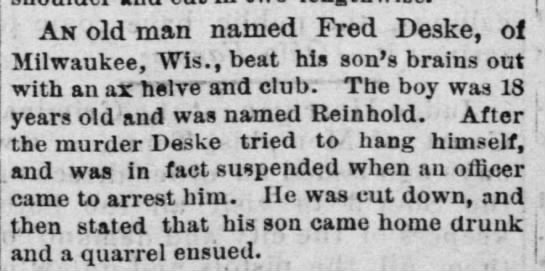
Murder of Reinhold Deske

Murder of Reinhold Deske -

I could only find the same article in several papers. The murder would have happened before Jan. 10, 1882 in Milwaukee, Wisconsin.

SOURCES:
St. Louis Globe-Democrat January 10, 1882
The Greeley News January 12, 1882
Kingman County Citizen January 19, 1882
The Patron of Husbandry January 21, 1882

Thursday, December 24, 2020

Murder Ballads: Murder of Delia Green


The murder of young African American Delia Young may have been the inspiration for the folk songs "Delia" and "Delia's Gone"

By Christmas Eve 1900 14-year-old Delia Green and14-year-old Cooney Houston (sometimes referred to Mose or Moses) had been dating for months by then. The two were at the home of Willie and Emma West on 113 Ann St. which was one block from Delia's home in Savannah, Georgia.

The West's were having a Christmas Eve party at their home. There were quite a few people who joined the party. At 3 A.M. on Christmas day Delia and Cooney were still at the party. It was said that Cooney was loaded. There are contradictions on whether he was the only one drunk or not at the party.

Witnesses claimed that Delia was mad at Cooney. He was teasing her, calling her his wife. He was joking around that they'd had a sexual relationship and wasn't talking to him at the party. Sometime during the argument, she called him a "Son of a Bitch." This angered the boy.

A shot was fired into Delia's groin area. She was dead and Cooney had the gun. He decided to run. Willie West then caught the 14-year-old and handed him over to patrolman J.T. Williams. J.T. Williams said that Cooney confessed to shooting her. That they had gotten in a fight and she called him a son of a bitch. This angered him and he shot her and said he would do it again.

At his trial, he wore shorts to make people realize he was young. He also backtracked on his confession and claimed that the gun had gone off accidentally. He said the Willie West asked the boy to retrieve his pistol from the gunshop. He still had the gun on him when he came back from a second errand of getting more alcohol. Willie Mills told the court that he witness Eddie Cohn and Conney fighting over a gurn and it accidentally went off.

Other witnesses called out the lies. They stated that Willie Mills wasn't at the party at the time. He had left earlier. Eddie had also left the party earlier and didn't even struggle with the boy over a pistol. No one believed this story.

He was found guilty, but because of his age, the judge gave him life in prison instead of the death penalty. He was then paroled by Governor John M. Slaton 12 years later 1913. His life is unknown, but he had died in New York City in 1927.

The ballads never state or ignore the fact that the two were in their early teens. The Delia's gone version (found above) makes it seem as if  Cooney or the killer was intentionally seeking out to kill Delia that night. Which wasn't true it was a bad and childish decision. It's doesn't excuse Cooney's crime, but it wasn't intentional. But now you know the tragic background to this murder ballad.

SOURCES:
Wikipedia
Country Daily 
Murder By Gaslight 
Find a Grave
Haunted Savannah Tours

Wednesday, August 19, 2020

Murder of Irene Violet Munro

In 1920 17-year-old Irene Munro was working as a typist in London, England. She was on vacation alone in Eastbourne rather than take the yearly trip to Portobello to visit family. Her mother helped her plan everything out and Irene would leave on 16 August 1920 to the south coast. She intended to stay at 393 Seaside in Eastbourne. When she arrived she sent her mother a letter informing her of her safe arrival and her intentions to buy gifts for the family.

She would pay Mrs. Ada Wynniatt, the landlady, 30 shillings in advance for the weekly cost of the room. The landlady would state that she soon warmed up to the young woman. on 18 August 1920 Irene would send her a second letter detailing her previous day. Even though Irene seemed to have been happy initially she confided in Ada that she wished she went to Scotland with her family.

On the 19th she would encounter 19-year-old Jack Alfred Field and 29-year-old William "Billy" Thomas Gray. The two offered friendship and to show Irene some local landmarks and go to a local pub afterward. Irene would return to her hotel for lunch and then agreed to meet the two afterward at the bus stop across from Archery Tavern, close to the village of Pevensey. She would leave shortly before 3 p.m. and told the landlady of her intentions of going to Hampden Park.

At the same time, Jack and Billy as the Albermarle Hotel saloon bar knew him as they spent some time at the bar before meeting Irene. Jack would become flirtatious with one of the barmaids and after she refused to give them a free drink Jack would respond with "Very well if you wait, until the evening, we shall have more money by then." They left the bar around 2:30 p.m. and headed to the bus stop.

Irene would arrive at the bus stop first. The men would arrive and a witness stated she was talking amicably towards them as they walked towards the Crumbles (a beach). Jack would be seen walking arm in arm with each other. This friendly encounter would not last long.

Once the three came to a secluded spot of the Crumbles around 300 yds from the closest inhabited property and within sight of the Pevensey Castle. Irene stated to the duo that she was tired and was going to reach into her silk handbag for a handkerchief to dab her face. As she was doing this the duo nodded to each other and began their plan.

Jack held his walking stick to shoulder height and Billy grabbed for Irene's purse. She fought hard for her purse and began shouting "Hey, what do you think..?" Before Jack hit her in the mouth with a walking stick. This would result in two teeth dislodging and loosening others. She also fell backward from the hard hit.

Irene would scream in pain. Billy would grab a section of ironstone brick weighing 32 lbs and began hitting her among her face. She would have likely died from shock during the attack, but it was possible that she died 30 minutes later from her injuries though deeply unconscious.

Her murderers would then quickly rob her of her items. They would take her 9 ct ring and purse. They would quickly bury the teen. Her grave was only 4 ft deep and covered her body with her coat and her hat over her face. One of her feet would be above the ground.

On that same day, Jack and Billy went to the Albermarle Hotel saloon bar and seemed to be "flushed" with money even though in the weeks leading up they spent almost nothing at the bar. The two came to the bar that night also wearing nice suits. Thomas was wearing a herringbone suit and Jack was wearing a dark suit with a cloth cap.

The next day a little boy named Walter Weller was also visiting Eastbourne with his family was playing around on the beach. He was running down a steep area on the beach when he tripped over something. He would turn to see what he tripped over it was a single foot sticking out of the ground. The little boy would tell his mother and would return with their landlord and his father.

The two men were soon suspects and on the 24th they were interviewed by the police. The two men would tell police that they spent the evening with each other and ate dinner that Billy's wife made. Witnesses couldn't pinpoint the two suspects. This allowed the two to be released from custody on the 26th.

A bus driver, George Blackmer, who saw the three at the bus stop identified the two men though. He knew them both well and stated that they met a dark-haired teenage girl who greeted the two when she saw them. When shown a photo of Irene he stated that it was her he saw. A sailor would come forward after recognizing Irene from a newspaper. He came forward stating he saw two men with her. He would also positively identify the two men also. This would lead to their arrest.

It was found that the motive was robbery. After the two men were discharged from the armed forces. Neither one wanted to work and turned to crime in order to get money.

On 13 December 1920, the trial will begin. Jack and Billy would both pleaded not guilty. The trial would last only 5 days ending on 17 December. They were found guilty and given the death sentence.

Both men were executed on 4 Feb. 1921 at Wandsworth Prison.

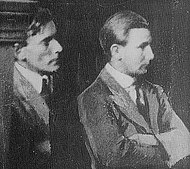
Photo of Billy Gray and Jack Field at the trial.


SOURCES:
Wikipedia
The Guardian August 23, 1920
The Express and Telegraph October 25, 1920
Truth November 34, 1920
The Times December 15, 1920
The Time  December 16, 1920
The Daily News January 19, 1921

Thursday, August 6, 2020

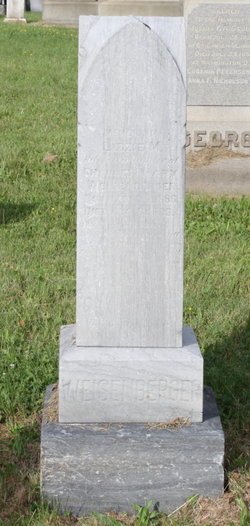
Murder of Lizzie Weisenberger


By the spring of 1899 13-year-old Lizzie Weisenberger was living with the Snell family in Washington, D.C. for 5 years. She was hired as a companion for their daughter Blanche. Her family knew the Snells and trusted them. But by spring of 1899, Lizzie who was previously happy with the arrangement was now unhappy. 

She would start to beg her mother to let her come home. It had turned out that 57-year-old Benjamin Snell, Blanche's father, was molesting Lizzie. She would tell her mother what he was doing to her and she let her come home. She would then try to keep Benjamin from Lizzie. It's not stated whether or not Lizzie's father, Karl, knew about what Benjamin did to her. 

Benjamin would start to beg for Lizzie to come back. 

At 6 a.m. Benjamin came to the Weisenberger home and asked for a glass of water. There was no water in the home so Karl left with a bucket to get some. Once Karl left Benjamin went into the home. Inside Lizzie was still asleep and her mother was in the kitchen cooking. When she saw him she screamed at him to leave. Instead, he rushed to Lizzie's room.

Her mother followed him but was not fast enough to stop what he planned. He would take a razor out, grab the girl by her hair waking her up, and slice the girl's throat twice. "Yes, I cut her throat, and I will cut yours, too!" He screamed at her mother. He would slash the razor at her cutting her arm before he fled the home.

A mounted police officer, Pat Creagh, would quickly find Benjamin. He had the razor in his hands and stated "I didn't mean to do it. I wouldn't be surprised if I hanged for my folly." Officer Creagh disarmed him and Benjamin would follow meekly. He was also said to be confused about why he was being arrested that he

Benjamin's defense would try to get an insanity plea for him. Stating that mental illness and alcohol was the reason for the murder. He said that a head injury that led to epilepsy was the cause and that bad blood was another as his parents were also cousins. He would then claim that he didn't remember the murder. Throughout the trial, his family stayed by his side.

The jury would find Benjamin guilty. He was set to be executed. By the time that he was executed he lost about 60 lbs and became mentally unstable. His family would beg for clemency. He would hang on June 29, 1900.


SOURCES:
Legal Executions in Delaware, the District of Columbia, Maryland, Virginia, and West Virginia page 19
Find a Grave
New York Daily News
Horror History
Washington Times August 13, 1899
Evening Star
The Baltimore Sun June 29, 1900
The Weekley News July 3, 1900

Thursday, July 30, 2020

Murder of Maggie Walker

Copy of the pamphlet given out prior to execution for 10 cents.
In May of 1879, 16 to19-year-old Maggie Blair ran away from home from Jonesboro, Tennessee to Russellville, Tennessee. It isn't stated why she ran away, but it's believed that her Stepfather Anthony Blair was a part of the reason. Maggie was described as a smart, and industrious girl.

Maggie was working for Esquire William Donaldson and his family. On July 29, 1879, Anthony showed up to the home of the Donaldson's. He had found out that Maggie was there and had ridden the train to get her. He walked into the kitchen and demanded she leaves with him to talk.

At the time Maggie was in the kitchen with Mrs. Donaldson preparing a meal. Maggie seemed afraid and told him she wasn't going outside with him and if he had anything to say he could say in front of Mrs. Donaldson.

Mr. Donaldson was arriving home at the same time. He had forced Anthony to leave the residence. Anthony didn't show up again till the night of July 30th a few nights later.

On the night of July 30th Maggie went up to a colored church near Russellville for a prayer meeting. She had gone with friends. After the prayer meeting, Anthony showed up again. He had found people who were at the prayer meeting.

Anthony went by the group, but went a short distance and took another road in which Maggie and other young folks were walking. He walked through the crowd up to Maggie who was walking in the back with Henry Taylor.

Maggie filled with fear as Anthony pressed Taylor away and grabbed Maggie's hand. “You must go home with me on the train to-night to your grandpapa,” He stated as he dragged her 150 to 200 yards down the road all while she struggled to get out of his grasp. She screamed that she would rather die than go back with him.

This enraged Anthony and he pulled out his gun and shot her twice. She didn't immediately pass and it had taken her 2 days to die from her wounds on August 1st. On August 8th Anthony Blair to be convicted and sentenced with the death penalty.

It was said when they delivered the death penalty that Anthony may have been the calmest person in the room. He just stared at the judge. He was due to die on September 26, 1879. He had made a deal with local doctors that he would will over his body after death for $15. This allowed to let him keep a supply of tobacco and candy.

On September 26, 1879, 26 guards went to Anthony's cell at noon. Anthony seemed unaffected and walked with a firm step to the wagon that would bring him to the gallows. After religious services were done by Rev. Geo. Branner Anthony sang a song and then talked for 30 minutes.

He stated his guilt but presented his facts for the reason it leads to him killing Maggie. The newspaper wouldn't state these facts as it was unsuited for the public to read/hear. At 1:30 a rope was placed around his neck and the black cap arranged. Buy 1:35 the wagon pulled away from beneath him. He had no pulse at 9 minutes, in 10 minutes his heart stopped beating, in 15 he was pronounced dead, and in 22 he was lowered into the casket.

His body was taken by the Doctors who paid him for it. medical students and doctors embalmed the body. His heart and brain were kept in jars. They boiled his bones in 1880. They were assembled and hung in the backroom of a Drug Store. They were used as a way to attract visitors to the store. A fire eventually broke out and burned down the store.

SOURCES:
Reasonable Doubt
Executed Today
The Olden Times 
Wikipedia
The Morristown Gazette
The Knoxville Daily Chronicle 
The Knoxville Daily Chronicle