Showing posts with label Teenage Victim. Show all posts

Tuesday, October 29, 2024

UNIDENTIFIED: October 30, 2019 Concord, New Hampshire Jane Doe

 In 2019 a woman came to the the New Hampshire State Police and handed over a human cranium. She told them that her husband had found the partial skull in the 1930s in a pond in Concord. It was found that the skull belonged to a teenage girl between 15 and 18 years old. Bomb Pulse Testing on the skull showed that she did die before 1942.

Jane Doe was between 15 and 18 years old. 

SOURCES:

Wednesday, February 14, 2024

Death of George Spencer Millet


February 15, 1909, was George Millet's 15th birthday. The boy worked at a well-known insurance company in the NY Metropolitan Life Building in Manhattan, New York. On this day he would show up to work. The boy was well-known in the office. All throughout the day his female coworkers teased that they would give him a kissing spree after work.

At 4:30 pm the six stenographers would chase the shy teenager playfully. Before the chase he had apparently just placed it in his pocket and which was a 6-inch metal tool in the shape of a knife. In the chase, he would slip and fall. He would scream "I'm stabbed" before going unconscious in a pool of his own blood. When he had fell the ink eraser in his shirt pocket pierced his heart stabbing him.
 
One of the girls went to help him automattically,but passed out from the sight of blood coming from his chest. On the way to the hospital, George would pass away. 

His grave says: 

LOST LIFE BY STAB IN FALLING ON INK ERASER EVADING SIX YOUNG WOMEN TRYING TO GIVE HIM BIRTHDAY KISSES IN OFFICE METROPOLITAN LIFE BUILDING.

Thursday, August 6, 2020

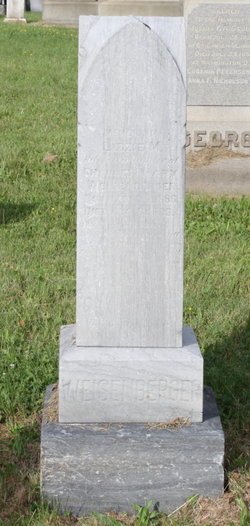
Murder of Lizzie Weisenberger


By the spring of 1899 13-year-old Lizzie Weisenberger was living with the Snell family in Washington, D.C. for 5 years. She was hired as a companion for their daughter Blanche. Her family knew the Snells and trusted them. But by spring of 1899, Lizzie who was previously happy with the arrangement was now unhappy. 

She would start to beg her mother to let her come home. It had turned out that 57-year-old Benjamin Snell, Blanche's father, was molesting Lizzie. She would tell her mother what he was doing to her and she let her come home. She would then try to keep Benjamin from Lizzie. It's not stated whether or not Lizzie's father, Karl, knew about what Benjamin did to her. 

Benjamin would start to beg for Lizzie to come back. 

At 6 a.m. Benjamin came to the Weisenberger home and asked for a glass of water. There was no water in the home so Karl left with a bucket to get some. Once Karl left Benjamin went into the home. Inside Lizzie was still asleep and her mother was in the kitchen cooking. When she saw him she screamed at him to leave. Instead, he rushed to Lizzie's room.

Her mother followed him but was not fast enough to stop what he planned. He would take a razor out, grab the girl by her hair waking her up, and slice the girl's throat twice. "Yes, I cut her throat, and I will cut yours, too!" He screamed at her mother. He would slash the razor at her cutting her arm before he fled the home.

A mounted police officer, Pat Creagh, would quickly find Benjamin. He had the razor in his hands and stated "I didn't mean to do it. I wouldn't be surprised if I hanged for my folly." Officer Creagh disarmed him and Benjamin would follow meekly. He was also said to be confused about why he was being arrested that he

Benjamin's defense would try to get an insanity plea for him. Stating that mental illness and alcohol was the reason for the murder. He said that a head injury that led to epilepsy was the cause and that bad blood was another as his parents were also cousins. He would then claim that he didn't remember the murder. Throughout the trial, his family stayed by his side.

The jury would find Benjamin guilty. He was set to be executed. By the time that he was executed he lost about 60 lbs and became mentally unstable. His family would beg for clemency. He would hang on June 29, 1900.


SOURCES:
Legal Executions in Delaware, the District of Columbia, Maryland, Virginia, and West Virginia page 19
Find a Grave
New York Daily News
Horror History
Washington Times August 13, 1899
Evening Star
The Baltimore Sun June 29, 1900
The Weekley News July 3, 1900

Thursday, July 30, 2020

Murder of Maggie Walker

Copy of the pamphlet given out prior to execution for 10 cents.
In May of 1879, 16 to19-year-old Maggie Blair ran away from home from Jonesboro, Tennessee to Russellville, Tennessee. It isn't stated why she ran away, but it's believed that her Stepfather Anthony Blair was a part of the reason. Maggie was described as a smart, and industrious girl.

Maggie was working for Esquire William Donaldson and his family. On July 29, 1879, Anthony showed up to the home of the Donaldson's. He had found out that Maggie was there and had ridden the train to get her. He walked into the kitchen and demanded she leaves with him to talk.

At the time Maggie was in the kitchen with Mrs. Donaldson preparing a meal. Maggie seemed afraid and told him she wasn't going outside with him and if he had anything to say he could say in front of Mrs. Donaldson.

Mr. Donaldson was arriving home at the same time. He had forced Anthony to leave the residence. Anthony didn't show up again till the night of July 30th a few nights later.

On the night of July 30th Maggie went up to a colored church near Russellville for a prayer meeting. She had gone with friends. After the prayer meeting, Anthony showed up again. He had found people who were at the prayer meeting.

Anthony went by the group, but went a short distance and took another road in which Maggie and other young folks were walking. He walked through the crowd up to Maggie who was walking in the back with Henry Taylor.

Maggie filled with fear as Anthony pressed Taylor away and grabbed Maggie's hand. “You must go home with me on the train to-night to your grandpapa,” He stated as he dragged her 150 to 200 yards down the road all while she struggled to get out of his grasp. She screamed that she would rather die than go back with him.

This enraged Anthony and he pulled out his gun and shot her twice. She didn't immediately pass and it had taken her 2 days to die from her wounds on August 1st. On August 8th Anthony Blair to be convicted and sentenced with the death penalty.

It was said when they delivered the death penalty that Anthony may have been the calmest person in the room. He just stared at the judge. He was due to die on September 26, 1879. He had made a deal with local doctors that he would will over his body after death for $15. This allowed to let him keep a supply of tobacco and candy.

On September 26, 1879, 26 guards went to Anthony's cell at noon. Anthony seemed unaffected and walked with a firm step to the wagon that would bring him to the gallows. After religious services were done by Rev. Geo. Branner Anthony sang a song and then talked for 30 minutes.

He stated his guilt but presented his facts for the reason it leads to him killing Maggie. The newspaper wouldn't state these facts as it was unsuited for the public to read/hear. At 1:30 a rope was placed around his neck and the black cap arranged. Buy 1:35 the wagon pulled away from beneath him. He had no pulse at 9 minutes, in 10 minutes his heart stopped beating, in 15 he was pronounced dead, and in 22 he was lowered into the casket.

His body was taken by the Doctors who paid him for it. medical students and doctors embalmed the body. His heart and brain were kept in jars. They boiled his bones in 1880. They were assembled and hung in the backroom of a Drug Store. They were used as a way to attract visitors to the store. A fire eventually broke out and burned down the store.

SOURCES:
Reasonable Doubt
Executed Today
The Olden Times 
Wikipedia
The Morristown Gazette
The Knoxville Daily Chronicle 
The Knoxville Daily Chronicle

Sunday, May 17, 2020

The Yde Girl

Images of her and the 1992 reconstruction of her face. 

On May 12, 1897, a man working in the Stifveen peat bog near Yde, Netherlands a well-preserved mummy of a teenaged girl. They referred to the girl as Het Meisje van Yde in Dutch. Which is meant the girl from Yde.

Yde Girls' body wasn't turned over to authorities until two weeks after she was found. Due to the conditions that a bog has, it allows bodies inside of it to mummify. Her body went through some deterioration and decomposing due to mishandling. People also came to see the body and took hair and teeth from the body.

The mummy had Carbon-14 dating done on her. It was found she had died between 54 BC and 128 AD. She had died around 16 years old.  It was found she had scoliosis of the spine and stood at 137 cm and was short for her age. Her hair was nicely preserved as it was long and reddish-blonde hair. It's possible one side of her head was shaved, but sometimes this shaved feature is seen in bog bodies and it's possible that that side of her head was in oxygen a bit longer.  She was wearing a woolen cape and around her neck was a braided woolen band. The braided band was wrapped around her neck three times.

She had a stab wound to her collar bone, but it is unknown if this was what killed her. It's believed the stabbing happened when she unconscious as there were no defensive wounds.

Her name and story are lost to history. It's not sure why she had died or why her body was left in a Peat Bog. Some speculate that she was murdered or sacrificed. Others think that maybe the woolen band around her neck is evidence that she killed herself. It's not sure what really happened to the girl.

SOURCES:
Mummipedia
Awesome Stories
Atlas Obscura
Wikipedia


Monday, May 11, 2020

Murder of Miss Lydia Bell

 16-year-old Miss Lydia Bell was asked by a private in the York volunteers asked her to walk that night. She did so without telling her father between the night of May 11th and 12th of 1804 She snuck out of her Scarborough, England home around 9 p.m. leaving through a neighbor's home to not be seen by her family. The neighbor warned her not to go because the man she was meeting was married. She ignored their advice and left with him anyway. Her family became aware she snuck out and worried about her.

The next morning Lydia's body was found around 11 a.m. she was lying on the Cayton Sands about two yards in the water with her head towards the sea. It was obvious whoever killed her expected her body to be brought out to sea. She had been brutally killed. Her clothes were torn and it seemed as if someone tried to sexually assault her. She had been beaten about her face and had scars, and skin on her arm had been torn from the bone. It was obvious she fought back from her attacker.  Her killer had strangled her to death. There were footprints in the sand near her body but unfortunately didn't extend to either side of the beach.

There was a malicious rumor that she was pregnant and had jumped off of a cliff to kill herself. This was not true as autopsy did not show that she was pregnant was in fact murdered.

The York Volunteer was taken in and questioned. He claimed he wasn't acquainted with the girl, but did speak with her before her death. The neighbors who she left the home of state he was the one who they saw her leave with that night. Her sister stated he was the same man to ask her on a walk and her brother stated that he had also seen him talking to his sister another day. He was found to have an alibi and magistrate was satisfied with it and released him.

The family believed he did it. Her father wrote a letter to the newspaper stating that he wasn't claiming that the whole York Volunteer was bad, but the man who killed his daughter was. He felt that people who were in the York Volunteer would understand.

It was later found out that four "witnesses" from the York Volunteers, Val Nicholson, William Short, Jonathan Simpson claimed to see another York Volunteer with Lydia on Cayton Road. He was taken to trial but was acquitted for the crime as there was no evidence.

It turned out the four had committed perjury to protect Val Nicholson. All four had suffered torments from the murder with guilt, chronic nightmares, and untimely deaths. Shortly before Val Nicholson died he confessed to killing the teen girl.

SOURCES:
Historic UK
The Times 24 May 1804
The Ipswich Journal 26 May 1804
Aberdeen Journal, and General Advertiser for the North of Scotland 06 June 1804
The Hull Packet; and East Riding Times 10 July 1804
The Monthly Mirror Volume 17


The Orthodox churchman's magazine; or, A Treasury of divine and useful knowledge

Thursday, March 19, 2020

Murder of Mary Ellen Kearney

In 1866 19-year-old Mary Ellen Kearney and 21-year-old John Moran were seeing each other. Her father had learned of John's bad character and was refusing to let the two see each other. He forbid John from their home in Roxbury, Massachusetts.

It had turned out that Mary Ellen went to see John at his cottage the week before March 19, 1866. He wasn't home and while waiting for him she read a letter on the table. The letter was from a man named Mallory in Philadelphia who wrote to John telling him that the man they had garroted died from their injuries.

When he came home he asked her if she had read the letter. She admitted she did. She told him that she hoped he wasn't guilty of the crime and didn't get an answer. He snatched the letter from her hands and threw it into the fire. The two then went out on a walk. When they got to spot he threatened her with a revolver he had with him. He forced her to take an oath to not tell anyone of the letter's contents. She did and went home.

Fearing for her life and knowing that the oath was not binding she admitted of the contents of the letter and that John threatened to kill her on March 18th. At the time John was working at Grover and Baker's Machine Shop near her home.

On the 19th He came to Mary Ellen's home. John knocked on a window and called out to her to talk to him. She did so and when she opened the door he shot her. She staggered to the kitchen door and screamed "Oh Aunt I am Killed" as she fell to the floor. The ball came through her left side through her heart and out the right. It had killed her almost instantly.

John was already been gone by the time the physician came. On March 23rd he turned himself in to the police. He refused to answer questions. On May 24th the trial began. He was supposed to be hanged on Jan. 25, 1867, but his time was then commuted in early January to life in prison.

SOURCES:
The New England Farmer  March 14, 1866
The Daily Evening Express  March 23, 1866 (part 1)
The Daily Evening Express  March 23, 1866 (part 2)
Lewiston Gazzette March 28, 1866
The Pittsburgh Daily Post May 25, 1866
Harrisburg Telegraph- Jan 11, 1867
Intelligencer Journal -Jan 12, 1867