Showing posts with label 1850's. Show all posts

Wednesday, August 6, 2025

UNIDENTIFIED:August 7, 1853, Philadelphia, Pennsylvania John Doe

 On August 7, 1853, a man died or was found dead in Philadelphia, Pennsylvania. There is little information in this case. 

John Doe is a black male around 55-years-old.

SOURCES:

Saturday, May 17, 2025

Murder of James Walsh

 Around 1 am on May 18, 1853, 54-year-old James Walsh was found stabbed in a court area in 1 Pleasant Passage, Lower Holloway in London, England. He was unable to say much except it was a woman who stabbed him. But he was unable to say how it happened. He was taken to the hospital and died shortly after. 


SOURCES:

Monday, February 10, 2025

UNIDENTIFIED: February 11, 1854, in Philadelphia, Pennsylvania John Doe

  On February 11, 1854, in Philadelphia, Pennsylvania an unknown man died. There is little information in this case.

John Doe was a black male around 80-years-old. 

SOURCES:

Friday, January 10, 2025

Death of William Snyder/Bernard

On January 11, 1854, 13-year-old William Snyder went to a circus on Stockton st in San Francisco, California. There he would be grabbed by the ankles by Manuel Reyes.  He was swung by his heels by the clown and this would lead to his death. It was said the blood was coming from Williams's mouth. He would be sent to the hospital where he would die a few minutes after He would die from a rupture of the left pulmonary artery. The next day he would be buried.

Manuel was described as being a mentally handicapped clown. He was arrested for murder, but nothing came from it. Williams's cause of death was determined as accidental. Later he would be arrested for assault and battery upon an officer. During the court hearing he “commenced slapping his face as if a swarm of mosquitos were pestering him” and was muttering nonsense. 

In some articles, William's last name was Bernard instead of Snyder. 
Nevada Journal Jan 20, 1854

Thursday, June 13, 2024

UNIDENTIFIED: June 1858 London, England Baby John Doe

 In June 1858, an unknown baby boy was found on Hardwick St in London, England. The boy was not a newborn and was around 6 months old making his birth around or in December. It's not stated if his death was murder or not. He was buried at the  City of London Cemetery on June 14, 1858.

SOURCES:

Sunday, June 9, 2024

Murder of Georgiana, William, Cary, Harriet, Henry, and George Brough

Queen Victoria ruled Great Britain for 63 years. For all nine of her children, that she had in 17 years, she had wet nurses for each one. On November 9, 1941, future King Edward VII was born, and by the bedside was his wet nurse, Mary Ann Brough.

She would be dismissed soon after because she did not seem to follow instructions and did not seem to be able to provide proper nutrients for the future king. Even though she was dismissed no one would have known that she would have killed her own children 13 years later. 

Mary was married to her husband George. He worked for the Royal family just as his father before him had. Their family lived in Esher, England. They had 7 children together,19-year-old Mary, 11-year-old Georgiana (Georgy), 8-year-old William, 7-year-old Cary, 4-year-old twins Harriet and Henry, and 2-year-old George, and an unnamed child.
 
In 1854 he would suspect her of an affair as she would go out often. He would hire a private detective to follow his wife. On May 29th she would be seen meeting another man at the tavern The two would also be seen entering a questionable house. George would accuse her of cheating. Feeling betrayed by the woman he loved he left on June 6th. He also told her that he was going to come back for the children and take them away from her.  He would refuse to talk or communicate with her. 

On the night of June 9th Mary was in a bad place. She would put the children to bed and try to go to sleep in a chair. Her oldest daughter would ask her to go to sleep in bed around 9 pm. She would go to bed. The children would ask her to bring them barley water up until midnight. 

Mary would look for a candle though she had one lit by the chair. She said there was a black cloud above her. She could not see, however. She then would think about slitting her own throat and would search in the dark for her husband's razor. She would find his keys and then find his razor. 

With the razor, she would go to her daughter Georgy and slit her throat without looking at her. There was no resistance. She would then go to Cary and do the same. The next victim was Henry and he would say "Don't mother" and she would tell him "I must" before slitting his throat. She would move onto Bill turn him over and do the same. He never woke up. Harriet and George were the last ones and there was no resistance. Harriet however struggled the most as she died. Mary would then slit her own throat. 

She said that she lay there for a long time and then went to get a drink. She said that the black cloud was gone. It then hit her on what she did so she placed something bloody in the window because she could not call out to anyone. She then undid the bolt to the front door.

On the morning of June 10th two men, Mager and Peasley, were walking past the Brough home and spotted something shocking. There was a blood-soaked pillow on the second-story back window sill. The two men would notify neighbors of there being possible trouble at the home. They would first try to ring the doorbell, but no one answered. The landlady would come and do the same, but more urgently. 

Mary would then come up to a window and wave to them with a towel. One of the men would scale the wall and let the others in. They would come up to the house. Mary would not let them in as the door was locked. The man would see a ladder and climb through the window with the bloody pillowcase. 

Mary would come up to the top of the stairs to the man's sight and see her more clearly. She was a mess covered in blood. When she turned to him he saw that there was a wound on her throat. He went back down the ladder and someone went to get the doctor. 

John Crockford was in his garden when this happened. he spotted the commotion and they explained to him what had happened. He would also climb up the ladder and would go into the room of the bloody pillow. 

Mary was lying on her side in the room. In one of the beds was one of the children. The house was a bloody mess. He would then make his way to the front door to unlock it. Passing one of the rooms he would see two dead at the end of a bed. He would notice that there was a pair of bloody boots and stockings under a table by the door. The lock and door handle also was covered in blood. He would leave the house and inform them that the children were dead.

 Mary was still alive and bleeding out. She would be saved from her attempted suicide. 

19-year-old Mary and her father would then see the children at their funeral. They were both extremely saddened by the tragedy. Mary would have been another victim if she had been in the home that night. Mary Sr would will all of her items to her remaining child.

While recovering she would be charged with murder. On August 8th she would go to the Surrey Assizes. She would admit that she did not want her children taken away from her. She would use a defense of insanity and the jury agreed with this as they returned with a verdict of not guilty on the grounds of insanity. 

She would be ordered to be detained at her Majesty's Pleasure. 


SOURCES:
Murderpedia
Ranker
The Halifax Courier and Guardian August 12, 1854
The Sun April 24, 2018

Saturday, May 11, 2024

UNIDENTIFIED: May 12, 1850, Philadelphia, Pennsylvania Jane Doe

  On May 12, 1850, a woman died or was found dead in Philadelphia, Pennsylvania. There is little information in this case. 

Jane Doe is a black male around 80-years-old.

SOURCES:

Thursday, April 18, 2024

UNIDENTIFIED: April 19, 1854 Boston, Massachusetts Jane Doe

 On April 19, 1854, a woman's body was found in the water near Battery Wharf in the North End of Boston, Massachusetts. She appeared to have drowned recently as hours before she was seen. She was walking the streets and seemed to have been acting insane. 


The woman is about 35-years-old.

SOURCES:

Sunday, March 10, 2024

Murder of Stanislaus Bilansky

Mary Ann Evard Wright who went by her middle name Ann was born in Fayetteville, North Carolina in 1820. This was where and lived there with her first husband. He would unfortunately die in a railroad accident. She would move to Pleasant Hill, Illinois, and then settle in St. Paul, Minnesota in April of 1858.  She had moved there because her nephew, John Walker, was sick with Typhoid Fever.

Stanislaus Bilansky was born in Poland in 1807/1808. He had lived in Wisconsin, but then moved and settled in St. Paul in 1848. He was one of the first Polish Immigrants to St. Paul. He had been divorced twice previously and was in custody of his 3 young children. He was a poor man who owned a small cabin that doubled as a bar, and a grocery store. He was known to drink heavily. 

In September of 1858 Ann and Stanislaus would get married. Ann would frequently take care of the children when Stanislaus was ill or working. It was said that she was a good stepmother. However, the marriage was not perfect. Soon after Stanislaus would get sick and seemed to have hypochondria. He was also a violent drunk. 

February 28, 1859, Ann and her friend Lucinda Kilpatrick (20s) went shopping. The two went uptown to the post office to send letters and retrieve mail. They would then walk to W.H. Wolff's drugstore on Third St and Wabasha St. She went inside and asked for rat poison so that she could use it in the store since the mice were getting into the vegetables. She claimed her husband wanted it. The rat poison was too much though. 

The two would then go to Day & Jenks, a different drugstore, where Ann purchased a jar of arsenic for ten cents. Lucinda thought it was strange that they needed rat poison. She had never seen any or even heard about any mice in the Bilansky home. 
  
Stanislaus would become sick once again between March 6 and March 11th. It was thought to be indigestion, but his condition would worsen quickly. When his condition worsened he would take both alcohol and Graffenburg pills. No one believed that he was dying other than Ann. Lucinda would witness Ann sitting by her husband's bed. She would cry and ask what to do with the children if he died. 

Lucinda thought this was strange as no one thought he was dying. On March 10th Lucinda would sit with Stanislaus. He would tell her that "he had nothing to live for" and this worried her. She never heard him say anything remotely close to that before. 

She would tell him a small story to perk himself up. She would tell him a story of a sick man being taken care of by his wife. He recovered, but his wife died. Then the man would marry a young man afterwards. 

On March 11th Stanislaus was really bad. Luicinda's husband Andrew wanted to sit by Stanislaus's bedside. Ann refused that and refused to call a doctor. He would then pass away.

 A coroner's jury would determine that it was a natural death. He would be buried on March 12th. Lucinda would claimann asked her to take the blame for buying arsenic. She would tell the police about Ann asking him about what to do with the children, the rat poison, and the odd comments she made. 

On March 13th the body would be exhumed. Medical examiners would then find a trace that resembled arsenic. This would lead to Ann's arrest later that day. March 15 his nature of death would change. A new coroner’s jury ruled the death a homicide.

The murder trial would begin on May 23, 1859. Ann would claim innocence that she was not responsible for her husband's death. 

 Lucinda would go on stand to repeat what she told the officers and what led to the discovery of the murder. Another witness Rosa Scharf stated that Ann had changed with the door open after the funeral. That she did this even though her nephew, John, was in the home. She also stated that the two had a weird air about them and gave each other sneaking glances as if they were having an affair. 

She stated that one day they were sitting in the Bilansky home before Stanislaus's death. An old man would go past the window “I had better set my cap for him, for he has money,” Ann said. Rosa would state that a loveless romance would not be fulfilling. Ann would then respond “You could give him something to sleep himself to death.” She then would tell her how much poison would kill a man.

She also claimed that when she was doing dishes Ann warned her about Stanislaus's plates. She also noted that his meals were made separately from everyone else. That she should be careful about them. Also after the funeral Ann would say "Must of taken poison" which threw Rosa off since no one thought that was how he died. 

There was no solid evidence, only circumstantial. 

It was believed that Ann wanted out of her marriage and did so by poisoning Stanislaus. That she was in love with John and poisoned her husband because of it. 

On June 3td she would be found guilty. She would try to appeal her case on July 23rd but was denied. Within hours of finding out her appeal was denied Ann decided to escape. She escaped from the jail by squeezing through the window bars. She was not missing long as she was caught a week later. 

The case went to the state supreme court, though on narrow and technical grounds. The court denied the defense’s appeal on July 23. Within hours of learning her appeal had been denied, Ann Bilansky escaped from jail by squeezing through window bars. Authorities caught her a week later just a few miles away.

On December 2, 1859, Judge Edward Palmer would give Ann her sentence. She was to be executed. Then Governor Alexander Ramsey would set March 23rd as a hanging day. Ann had some hope though as she had many supporters, a new attorney who was former territorial governor Willis Gorman, and two more avenues to pursue. 

On March 5, 1860, the legislature passed a bill commuting Bilansky’s sentence to life in prison. This would be vetoed though by Governor Ramsey, whose brother Justus had served on the jury. Throughout all this, she would maintain her innocence. 

She would be the only woman executed in Minnesota. She was executed on March 23, 1860. 

These were her last words;

“I die without having had any mercy shown me, or justice. I die for the good of my soul, and not for murder. May you all profit by my death. Your courts of justice are not courts of justice — but I will yet get justice in Heaven. I am a guilty woman I know, but not of this murder, which was committed by another. I forgive everybody who did me wrong. I die a sacrifice to the law. I hope you all may be judged better than I have been and by a more righteous judge. I die prepared to meet my God.”

Wednesday, January 3, 2024

UNIDENTIFIED: January 4, 1851


On January 4, 1851, someone died or their body was found in Montgomery County, Ohio. Their body was buried at Old Greencastle Cemetery in Dayton. Gender was not stated on the tombstone, but the age listed is 24-years-old. 

SOURCES:

Monday, August 14, 2023

UNIDENTIFIED:August 15,1853 Orleans Parish, Louisiana Orphaned German girl

 On August 15,1853 an 8 to 9-year-old Orphaned German girl would die from yellow fever in Orleans Parish, Louisiana. Her identity would be unknown. She would be buried at Cypress Grove Cemetery 2 in New Orleans.


SOURCES:
Find a Grave
Unidentified Wiki

Saturday, October 29, 2022

End of Watch: Murder of Constable James Corcoran

On October 30, 1850, in Philidelphia, Pennsylvania. 32-year-old Constable James Corcoran spotted a man who had a warrant for assaulting his wife. He arrested the man. They were only a few blocks from the magistrate's office and when they were on Vine St and 13th St the man kicked the constable in the abdomen twice. He would flee.

A citizen saw what had happened. The citizen walked the Constable back to the magistrate's office. The citizen reported what had happened and was deputized to arrest the man. The citizen and Constable Corcoran went to serve the warrant. The subject was spotted walking past the magistrate's office and he was quickly arrested. 

Constable Corcoran would return home and a doctor would be summoned the following morning. He was still having pain in his abdomen, and surgery was performed. His health would decline and he would die on November 1st. 

The man was charged with murder and was found guilty of manslaughter on March 21, 1851. A motion for a new trial was denied by a local judge the following month. 

SOURCES:

Criminal Justice Research Center

Criminal Justice Research Center PDF pg 32

Officer Down Memorial Page

Wednesday, October 26, 2022

UNIDENTIFIED: October 26, 1856 Stockton, California Antione

On October 24, 1856, a man around 36-years-old named Antoine was admitted to Ward No 2. to Stockton State Hospital in Stockton, California. He would die 2 days later on the 26th from Epilepsy. There is little information in this case. He was described as being an "idiot" and was French.  He was also a Charity Patient. 

SOURCES:

Unidentified Wiki

Find a Grave

Monday, February 7, 2022

UNIDENTIFIED: 1855 Nacogdoches County, Texas The Traveler


In about 1855 a Traveler got sick in Nacogdoches County, Texas in what is now Cushing. He would spend the night in the settlement and die. No one knew who he was and he would be buried at the Fuller-Nichols Garden Cemetary. 

SOURCES:

Find a Grave

Saturday, October 30, 2021

UNIDENTIFIED: October 30, 1858 Stockton, California Juan

 On September 15, 1858, a 24-year-old Portuguese man named Juan was committed to Stockton State Hospital, in Stockton, California by Judge M.C.Blake, a County Judge of California. It was Insanity caused by masturbation. At the time he was considered single and had no property. Unfortunately on October 30, 1858, Juan would die from marasmus or chronic malnutrition and would be buried at the hospital cemetery. 

SOURCES:

Find a Grave

Unidentified Wiki

Sunday, July 11, 2021

Murder of Dolores Martinez

 On July 12, 1853, Dolores Martinez was shot to death by an unknown person in Sonoratown near zanja, in California. 

There is little information in this case. 

SOURCES:

Criminal Justice Research Center (Excel Document)
Friday, September 18, 2020

Murder of Mr. Cook

A few days before September 18, 1852, a 74-year-old farmer named Tipple didn't like another farmer named Cook. Cook resided near Ancaster in Brantford, Ontario, Canada. Tipple met Cook near Cook's farm where they had a short argument. Tipple then shot Cook through his heart causing instant death.

Both were veterans. Cook was a soldier of 73rd Regiment and Tipple served on board a man-of-war. I could not find any other articles on this case. 

SOURCES:
Ottawa Daily Citizen  September 18, 1852

Friday, May 1, 2020

UNIDENTIFIED: 1854, Ontario, Canada Unknown Stranger


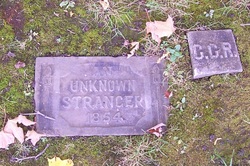
In 1854 a young man stayed at the Whitevale Inn, in Whitevale, Ontario, Canada. There is little information on this, but he had died during his sleep and had no identifying papers on him. It's not stated how long he'd stayed there or what exactly he died from. No one also came looking for the young man, and he was buried with a headstone saying "An Unknown Stranger 1854".

I couldn't find any other sources on An Unknown Stranger.

SOURCES:
Find a Grave